

Orchestrating Multifaceted Projects
- gestion de projets
- agents
- dashboards
- n8n
A project used to be one n8n workflow. Today, a project touches several facets at once: the interface, the database, the pipeline, the screens. Instead of a single workflow, it’s a complete chain. So I needed a sturdier project management tool, and a harness that moves these projects forward safely over long time horizons.
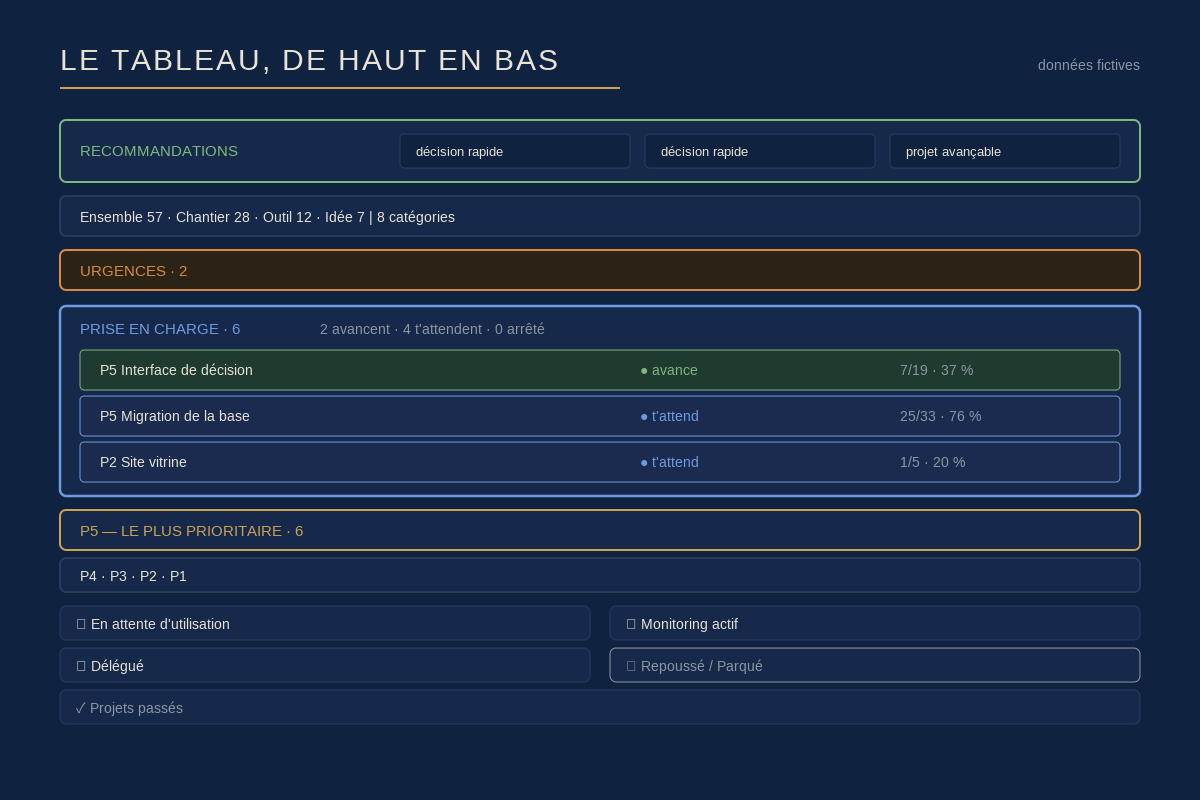
My main project board: At the top, no more than three recommendations: a quick decision, or a project that can move forward. Never a backlog. Then sorting by type (build, tool, idea) or by domain, and urgent issues: only real outages (image 1).
Next, the projects I’m actively driving. These are the ones I choose to move forward and actively monitor: a handful of projects, the most important ones or the ones I need in the short term. Right now, 57 projects are planned and five to eight are actively driven and running at any given time. The rest are ranked from priority 1 to 5. At the bottom are several sections: in use, delegated, being monitored, or parked. They stay visible, even when empty. Completed projects are set aside.
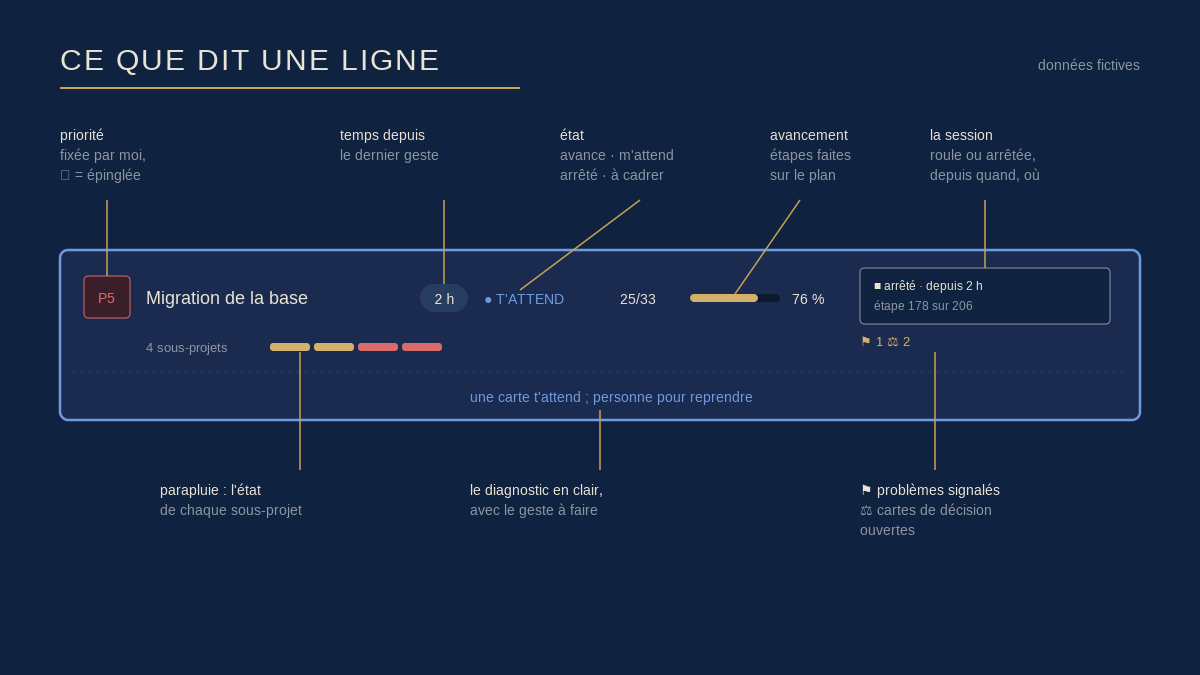
Every project is recorded in a database, with a trace of every action the agents take. I know in real time what’s happening on each one, and a single row sums it up: the priority I set, the time since the last action, the status (moving forward, waiting for my answer, stalled, needs scoping), the steps completed in the plan, the work session and how long it’s been running or since when it stopped. For an umbrella project, the status of each sub-project. Then the reported problems, the open decisions and a plain-language diagnosis, with the action to take (image 2).
When an agent reaches a choice that’s mine to make, it writes a card attached to the project: what needs deciding, why the question comes up, the options and its recommendation. I decide, and the work resumes.
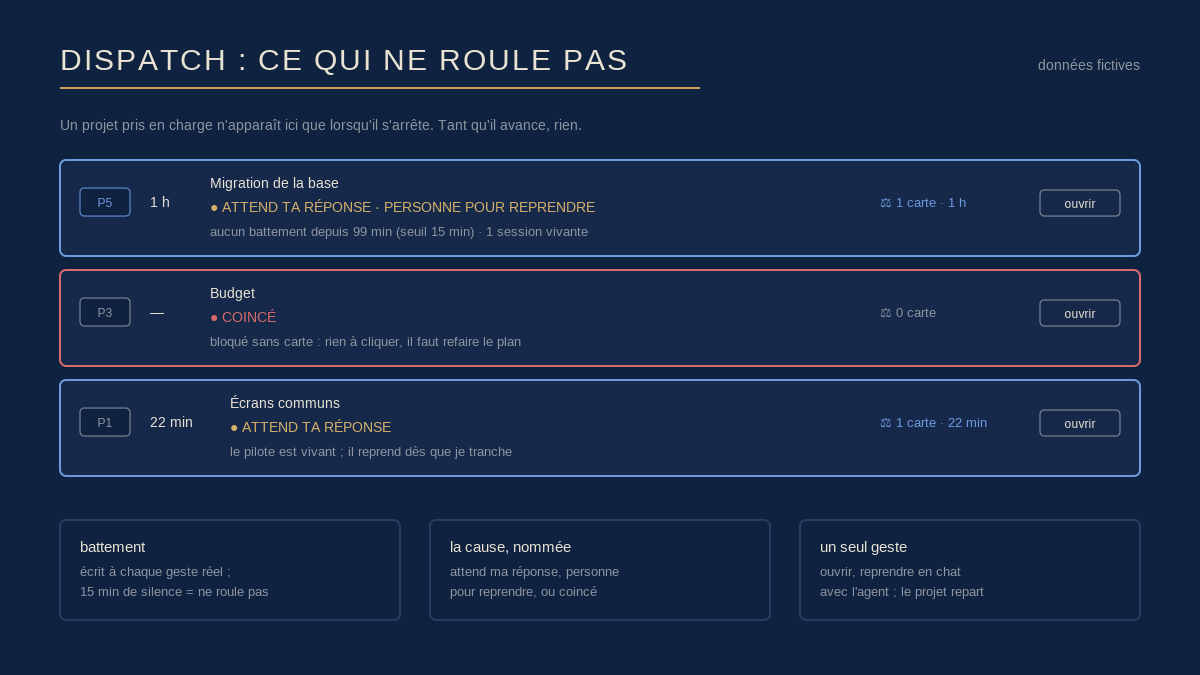
A daily management section shows me only the actively driven projects that are no longer moving forward, so I can stay on top of the important projects and move them forward as quickly as possible. Every real action by an agent writes a heartbeat that keeps the active project out of this zone; fifteen minutes of silence is enough to land it there (image 3).
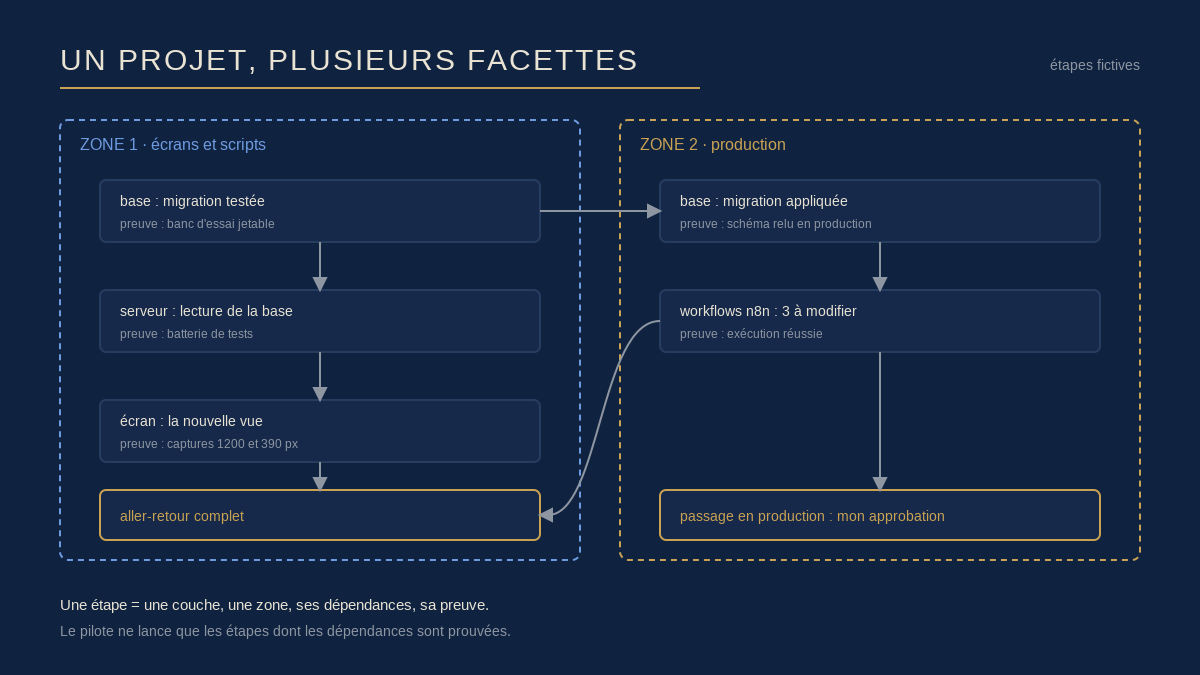
Every project carries a step-by-step plan. Each step has a layer, a zone, its dependencies and its proof of completion (image 4). Before launch, the plan goes through five checks, in order:
- The plan check. A script applies 23 rules. Each step fits within a single layer, depends only on earlier steps and keeps a bounded budget. Its proof actually runs and doesn’t validate itself.
- The premises. What the plan takes for granted is replayed for real: a service that responds, data that exists, access that’s already open. A false premise costs one line at the start; discovered along the way, it stops the project.
- The declarations. The plan names what might break further down the line, the approvals it will ask me for and the uncertainties that remain. An empty field is rejected.
- The review. An agent that didn’t write the plan reviews it against some twenty questions drawn from past incidents, and replays the proofs itself. It reports, it doesn’t fix.
- My approval. Once, on the whole plan, never step by step.
A single script delivers the verdict for the first four: green or rejected, with the rule at fault.
A pilot launches the steps that are ready and hands each one to a sub-agent. Each sub-agent has a narrow scope, one layer or one file, and a work budget. If it runs out before finishing, it stops and returns a partial report rather than pushing on. A step is only done if its proof passes; that proof is a deterministic script.
Freedom to act, coded limits. On anything reversible, the pilot decides on its own, notes its choice and carries on. Anything irreversible never goes through without me: production, spending, sending something to a third party. These limits are coded into the harness: an agent can’t get around them by deciding otherwise. The details: agent-driven project management.
How many facets did your projects have a year ago?