

What I told the Montreal n8n meetup
- n8n
- agents
- conference
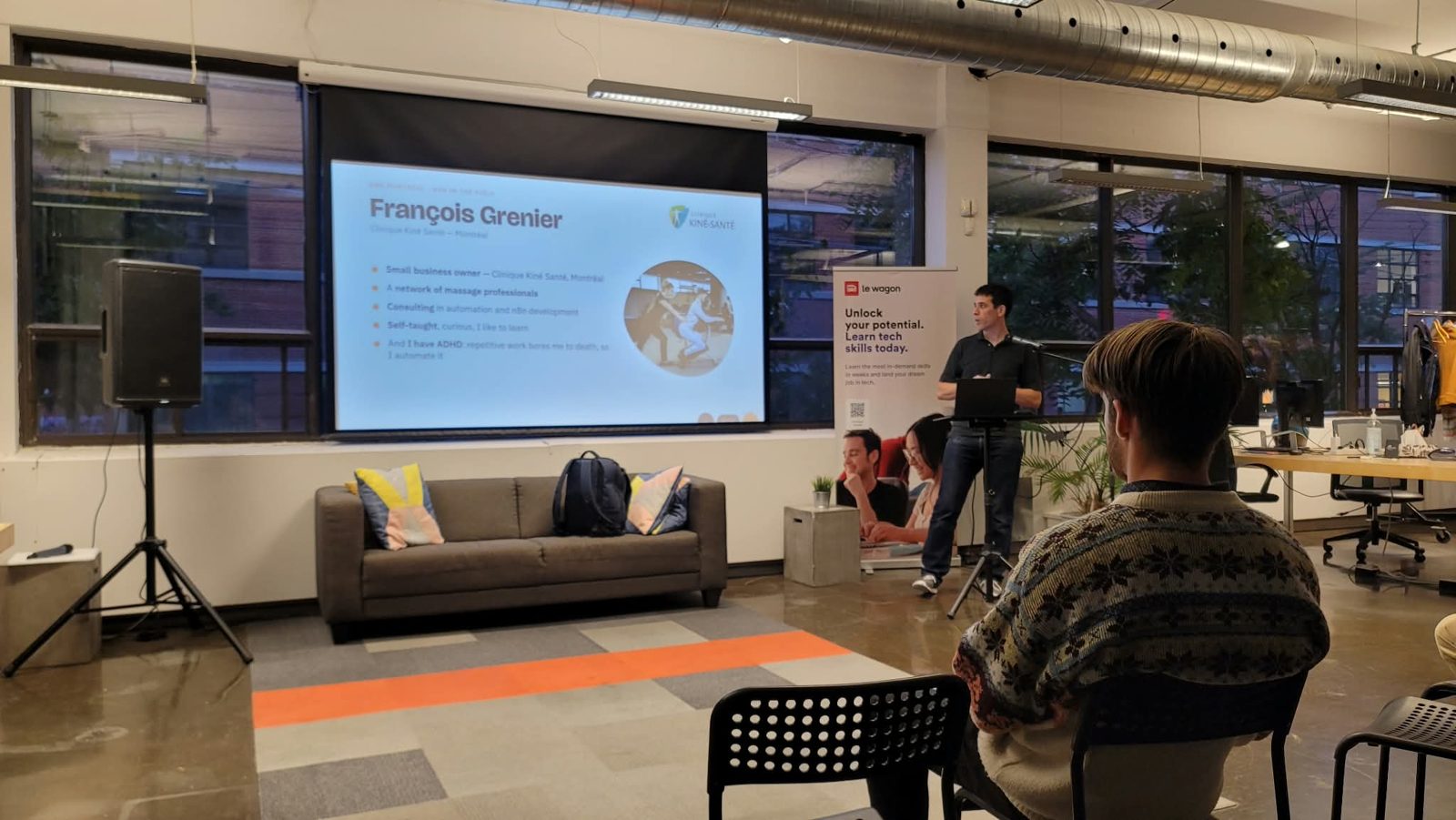
On September 23, I gave the keynote at the third Montreal n8n meetup, at Le Wagon, at the invitation of Félix Hini. The title: “n8n in the Field: Running a Business on 100+ Workflows.” For thirty minutes, in English, I told developers, professionals and curious entrepreneurs how I keep operating costs under control with n8n and the automations I have built on it.
A business that runs on its workflows
In 2019, my business grew dramatically: five times the 2018 revenue. Yet I lost a lot of money that year. Every new client multiplied the work around each event.
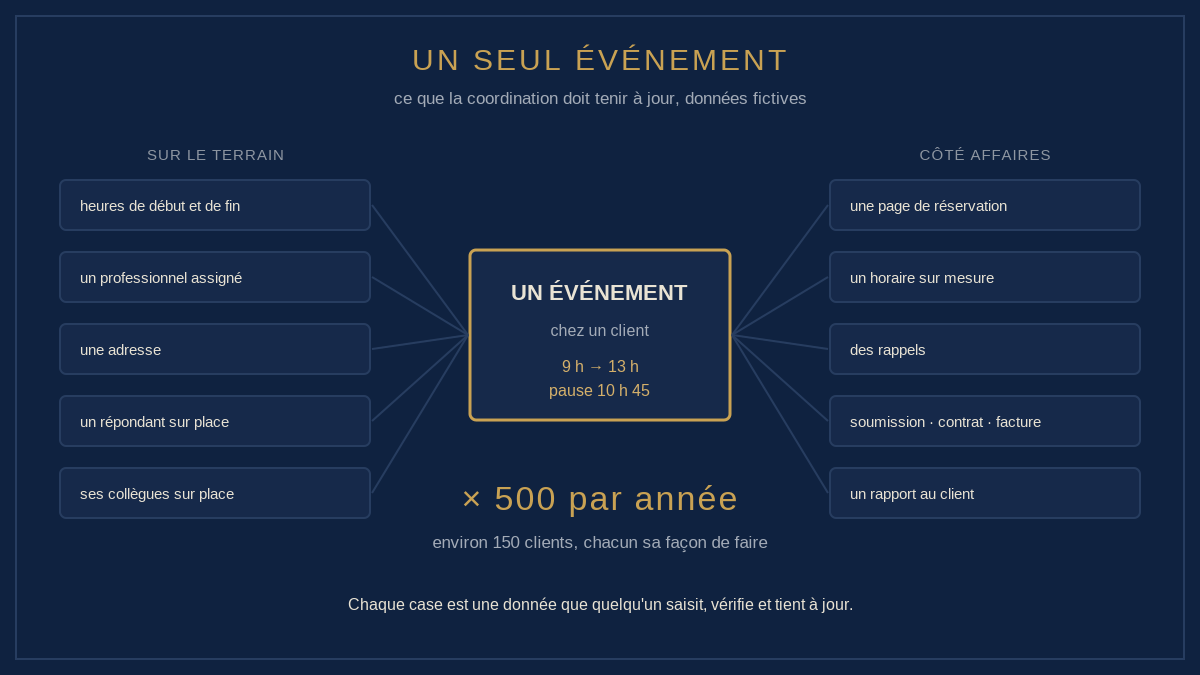
A single event at a client’s site has many characteristics: a start and end time, breaks, an address, an on-site contact, an assigned professional, a booking page, reminders, a quote, a contract and an invoice. Each box is a piece of data that someone enters, checks and keeps up to date. Multiply that by 500 events a year, for about 250 clients who are all different. That is when I knew I needed a solution, and automation became my best ally.
I started automating with Zapier in 2018, then switched to n8n in 2024. In January 2026, I had 120 workflows; on the night of the talk, I had more than 300. Today my infrastructure runs about 15,000 tasks a month and saves me a coordinator’s salary every year.
n8n has become the foundation of everything. An execution costs no tokens and can be easily traced and replayed. The tool is self-hosted and open source, so my data stays with me. And its return is easy to measure, in hours or dollars saved.
Artificial intelligence that builds the workflows
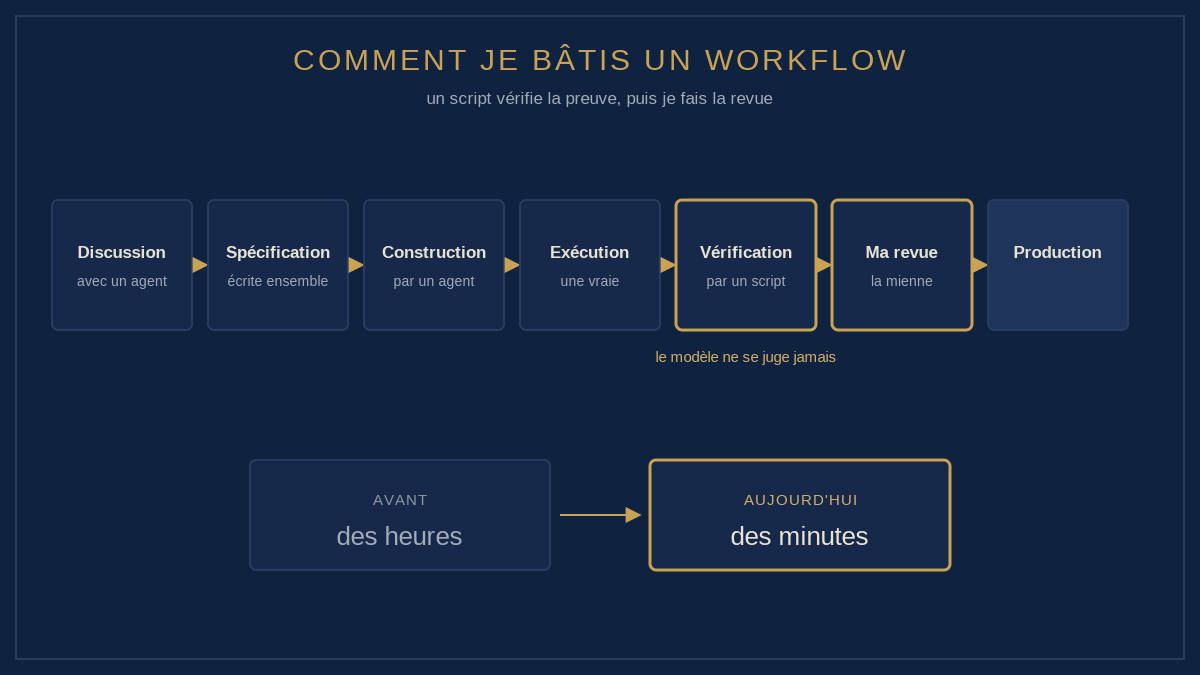
I use artificial intelligence to create the workflows that run the business. I discuss the need with an agent and we write the specification together. An agent then builds the workflow and runs it for real, and then a script, with no model, checks the proof. I do the review, and the workflow goes into production. What used to take me hours now takes minutes. All the details are in the workflow factory.
On top of the deterministic system, I created a bounded agentic layer that helps me with the different facets of running a business. In coordination, I have an agent that helps me with tasks using exactly the same workflows I do. Based on certain criteria, it can, for example, decide to send a confirmation email or wait until the next day if an email was already sent a few hours earlier.
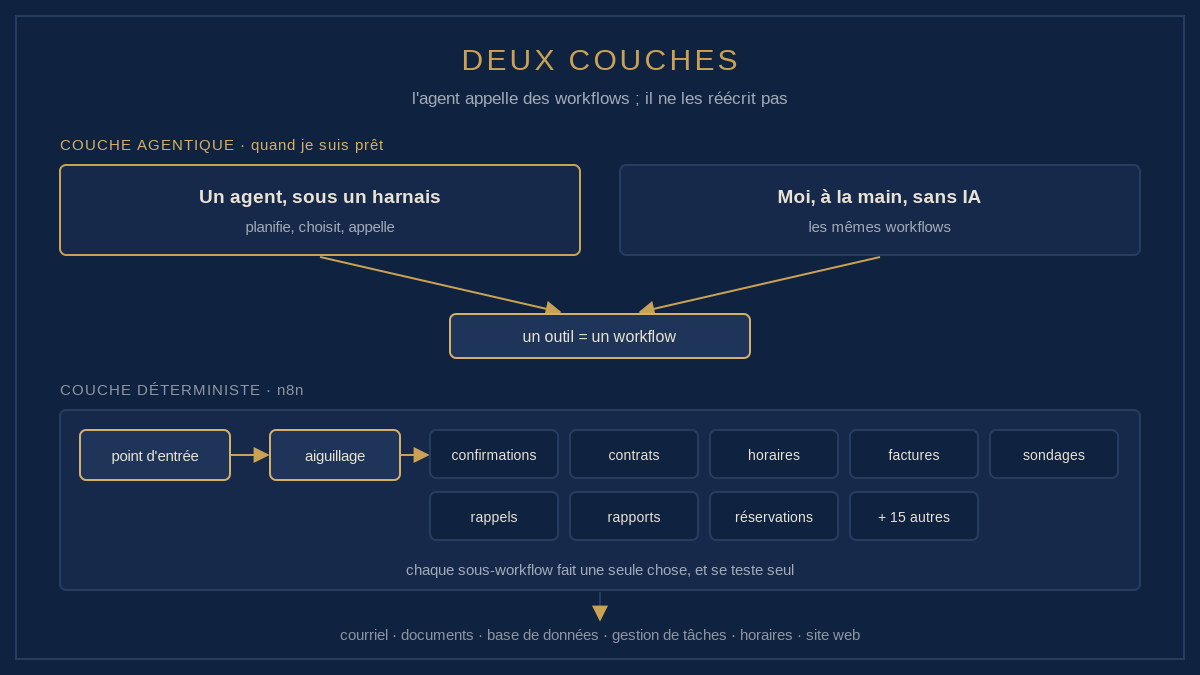
Guiding agents well is a complex craft that I am starting to understand. Giving them freedom of action while keeping their actions safe is an art, a bit like guiding young children who learn very quickly. I teach them to reuse a workflow rather than create a duplicate, to finish what they start and to respect neighbouring integrations. This supervision takes up half of my development time, and it is a fascinating craft: the harness, the context and the evaluations make all the difference.
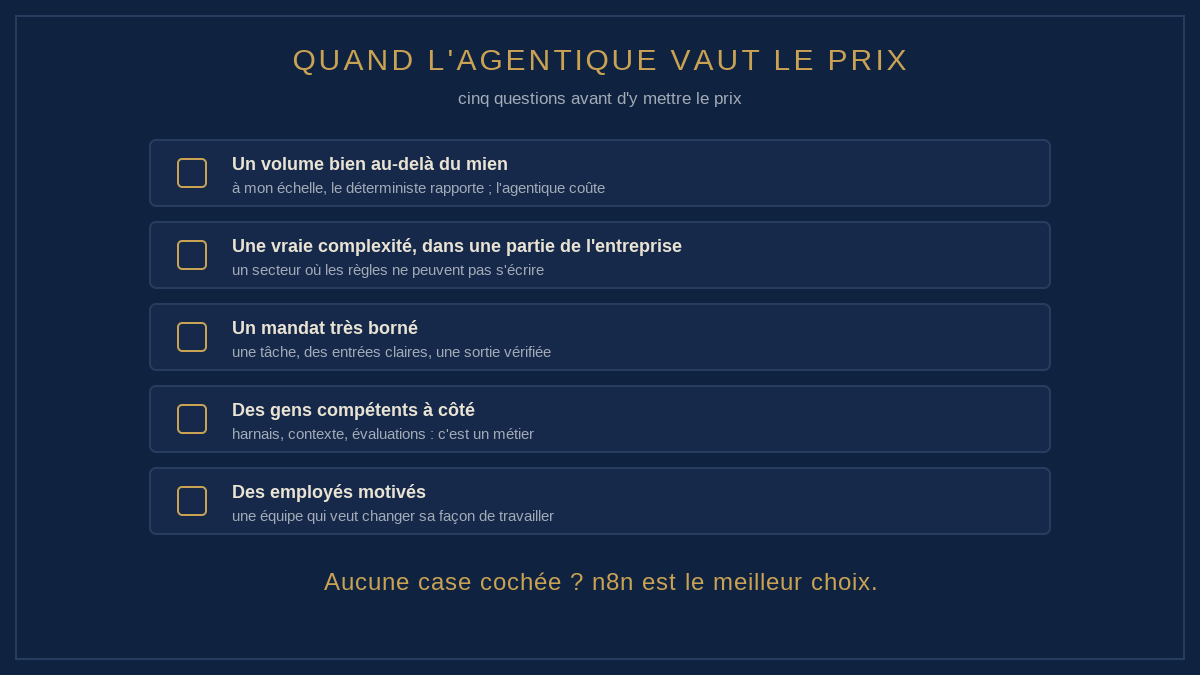
To wrap up the talk, I proposed a five-box grid that suggests points to consider when deciding whether or not to add agentic automation to your business. In most situations, n8n remains the better choice.
After the talk
The room’s reaction surprised me. Many people lined up to come talk to me, and the conversations went on for more than an hour. Some people had to leave before their turn came. Several also asked me for the slides.
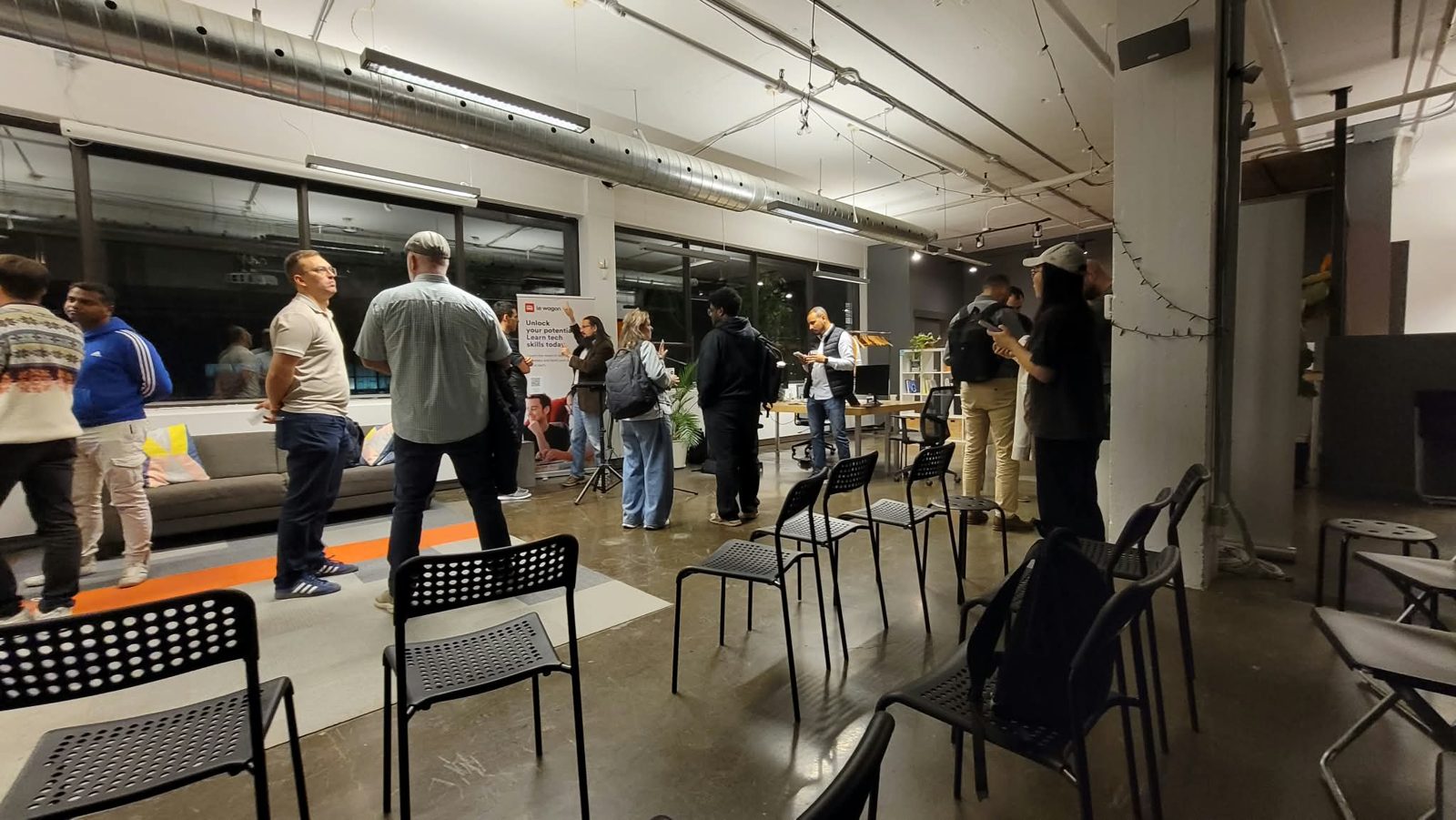
The questions surprised me just as much. People asked me about all kinds of topics, as if I were an expert in every field. What I remember most is that several people left wanting to build their first automation, to save time and keep it for what really matters.