

Augustus Lab: Building on a Roman Foundation
- agents
- Panthéon
- fondation
Augustus Lab was born from a very concrete need: a new server where Claude Code could work, and a name to christen it. I wanted an inspiration that spoke of foundations, of something built to last. Rome was the obvious choice: few civilizations have built so much, and so solidly.
For my first agent, the one that builds my automations, I chose the name Augustus. Augustus founded the Empire, and he is credited with this line: he found Rome in brick and left it in marble. The server, the lab and this site followed.
Other agents joined, each with a specific responsibility, and each was given the name of a Roman whose story fits its role. At the centre is the Forum: like Rome’s public square, it is where ideas arrive, get sorted, then are sent to the right place. Every part of my infrastructure follows the same theme.
Augustus builds and delivers the automations. Agrippa, Augustus’s right-hand man, was a general and a great builder: he had the first Pantheon built, along with several aqueducts. Mine finds and fixes whatever breaks. Cicero, the orator who knew how to put everything in order, receives a topic, hands it to the right specialists, then pulls together the synthesis.
Three advisors surround him. Seneca, after the philosopher, judges technical feasibility. Maecenas, after Augustus’s wealthy ally, judges business viability. Atticus, Cicero’s well-informed friend, does the research and goes looking for evidence.
Others keep the house in order. Tiro, Cicero’s secretary, who invented a shorthand and preserved his letters, files my documentation. Vitruvius, the architect who wrote the great treatise on architecture, keeps the big picture of the projects. Pollio is named after Asinius Pollio, who founded Rome’s first public library: he answers questions from the system’s memory before anyone comes to bother me. Finally, Cato, the unbending censor, reviews every plan before it is launched.
The Romans governed an empire by letter, and Cicero’s correspondence with Atticus has come down to us. My agents do the same: they don’t speak to each other directly, they leave one another missives in a shared register. A missive says what to do and for whom, then comes back closed when the work is done.
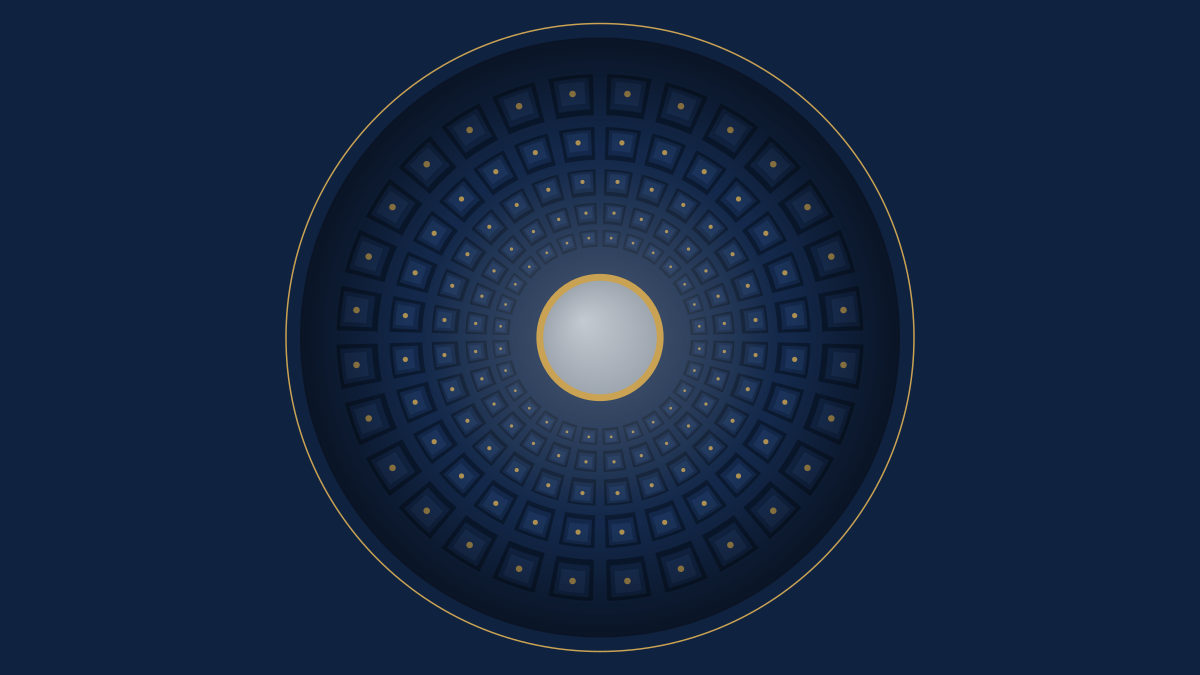
For the site, I chose the Pantheon, Agrippa’s work under the reign of Augustus and one of the most beautiful buildings ever built. The home page dome shows it seen from below (image 1). The small circle at the top of the page, which changes the colours, uses that same view: the ring of the dome and the oculus at the centre.
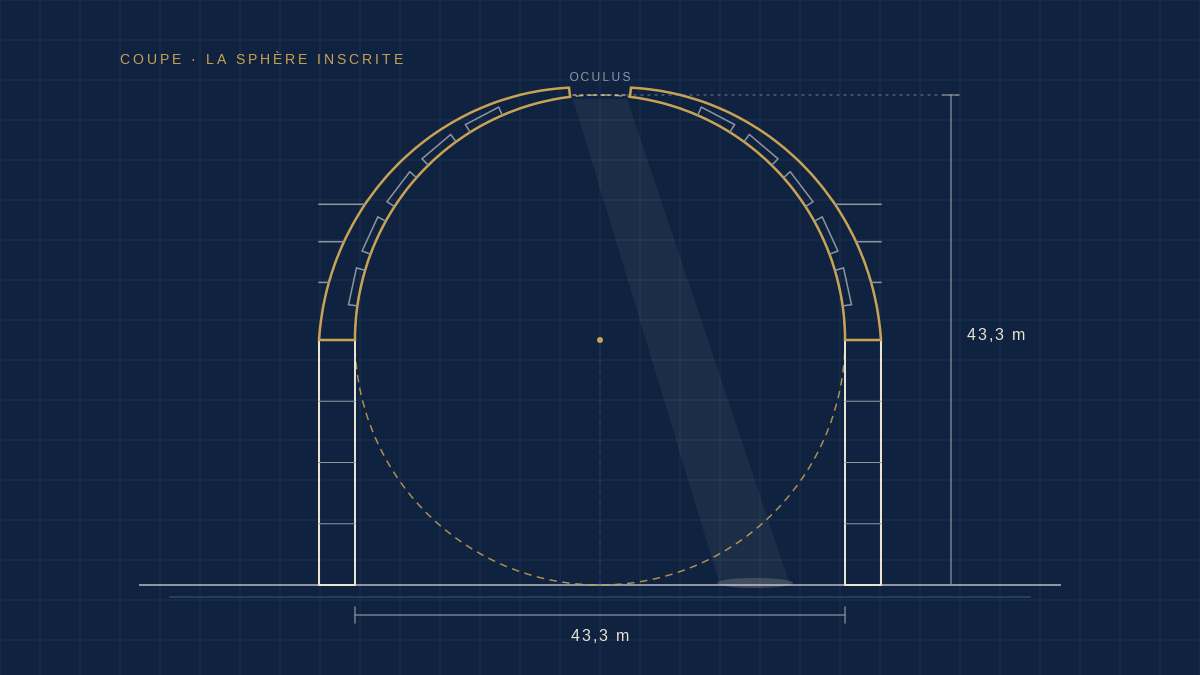
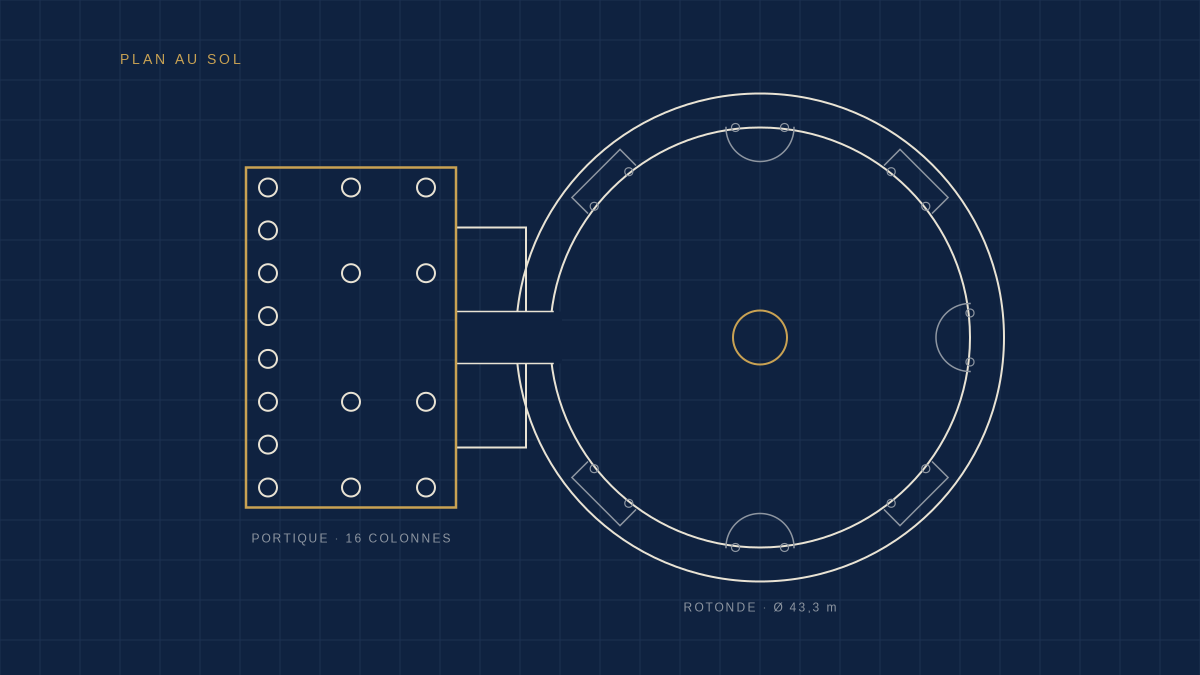
The Pantheon we visit today was rebuilt under Hadrian, around the year 125, but it still bears Agrippa’s inscription on its façade. Its unreinforced concrete dome measures 43.3 metres in diameter, and the top of the oculus is 43.3 metres above the ground: if you extended the dome, it would form a perfect sphere touching the floor (image 2, image 3). The Romans lightened the concrete as it rose, using pumice near the top, and carved five rows of twenty-eight coffers into it. It remained the largest dome in the world for more than 1,300 years, and it is still the largest unreinforced concrete dome today. The building has been in continuous use for nearly 1,900 years.
Augustus-lab.ca is a work in progress. I want to show what I am building and what is possible, to give others the urge to go further. I don’t come from programming: I run a services business. Artificial intelligence tools are now available at low cost, and they put within everyone’s reach tools that used to cost a fortune.
In an unstable world, where costs rise quickly and markets change from one season to the next, every business stands to gain by equipping itself to save time, money and energy, and to focus on what matters most.
Augustus Lab is here to encourage you to build your own tools.